GPT-5.6 is no longer just a rumor or a limited-preview story. OpenAI now frames the GPT-5.6 family as the intelligence layer behind ChatGPT Work and Codex: Sol for the hardest work, Terra for everyday work, and Luna for faster, cheaper volume tasks.
The official Asterism demo is small on the surface: GPT-5.6 builds a playable celestial card game in Codex. The useful part is not the game. It is the workflow: open-ended goal, tool use, sandbox processing, max reasoning, subagents, art, sound, testing, and iteration until the artifact is polished enough to share.
Official source: OpenAI's GPT-5.6 launch page, the ChatGPT Learn model docs, and the official Asterism Codex demo above. Additional embedded videos are creator commentary and workflow examples, not the factual source of record.
Source Note
OpenAI announced the GPT-5.6 family for general availability on July 9, 2026 after the limited preview. The official launch page says the family includes Sol, Terra, and Luna; introduces ultra as a multi-agent capability setting; and adds Programmatic Tool Calling for tool-heavy workflows.
The article below treats OpenAI's launch page, ChatGPT Learn docs, developer docs, and deployment safety page as the factual spine. The two additional YouTube videos are useful for seeing how builders are already interpreting the new Codex/Work surface.
Link Map
| Resource | Status | Builder takeaway |
|---|---|---|
| OpenAI GPT-5.6 launch | Official release | Source of record for Sol, Terra, Luna, benchmarks, pricing, safety, and availability framing. |
| GPT-5.6 preview post | Official background | Useful context for the limited-preview period, government access process, and early safety framing. |
| GPT-5.6 deployment safety | Official safety page | Read before giving GPT-5.6 long-running cyber, bio, browser, or computer-use tasks. |
| ChatGPT Learn models | Official docs | Explains model selection, Sol/Terra/Luna, reasoning levels, max, and ultra. |
| Programmatic Tool Calling | Developer docs | Use when code can filter, aggregate, call tools in parallel, or reduce intermediate outputs before returning to the model. |
| Using tools | Developer docs | Shows where Programmatic Tool Calling fits with tools, function calling, MCP, and hosted tools. |
| Latest model guidance | Developer docs | Use for current model-selection guidance before changing production defaults. |
| Asterism game | Official demo artifact | Example of GPT-5.6 using Codex and Sites to ship an interactive result. |
| Official Asterism video | Official video | Shows the Codex build loop: goal, tool calls, reasoning, subagents, art, sound, and iteration. |
| ChatGPT 5.6 changed AI forever | Creator commentary | Useful comparison framing against Fable 5 and the new ChatGPT/Codex harness. |
| GPT 5.6 Sol is here with Dan Shipper | Creator workflow demo | Shows Codex Desktop as a work operating system for email, Slack, feeds, apps, and small SaaS builds. |
What Changed
The jump is not just a new model number. GPT-5.6 changes the operating pattern around the model.
- Programmatic Tool Calling lets the model write small JavaScript programs that coordinate eligible tools inside a fresh hosted runtime.
- Max reasoning gives the model more time to think deeply about hard tasks.
- Ultra mode uses subagents for complex work that divides cleanly into parallel streams.
- ChatGPT Work gives GPT-5.6 a broader work surface: files, plugins, docs, slides, sheets, Sites, browser, local projects, and Computer Use.
- Codex desktop becomes less like a terminal helper and more like a project command center.
The official launch page says GPT-5.6 Sol sets new state-of-the-art results on several coding and agentic benchmarks, but the practical builder read is simpler: the model is better at long-running work because the surrounding harness lets it gather context, run tools, split work, verify outputs, and stay with a goal.
Sol, Terra, Luna
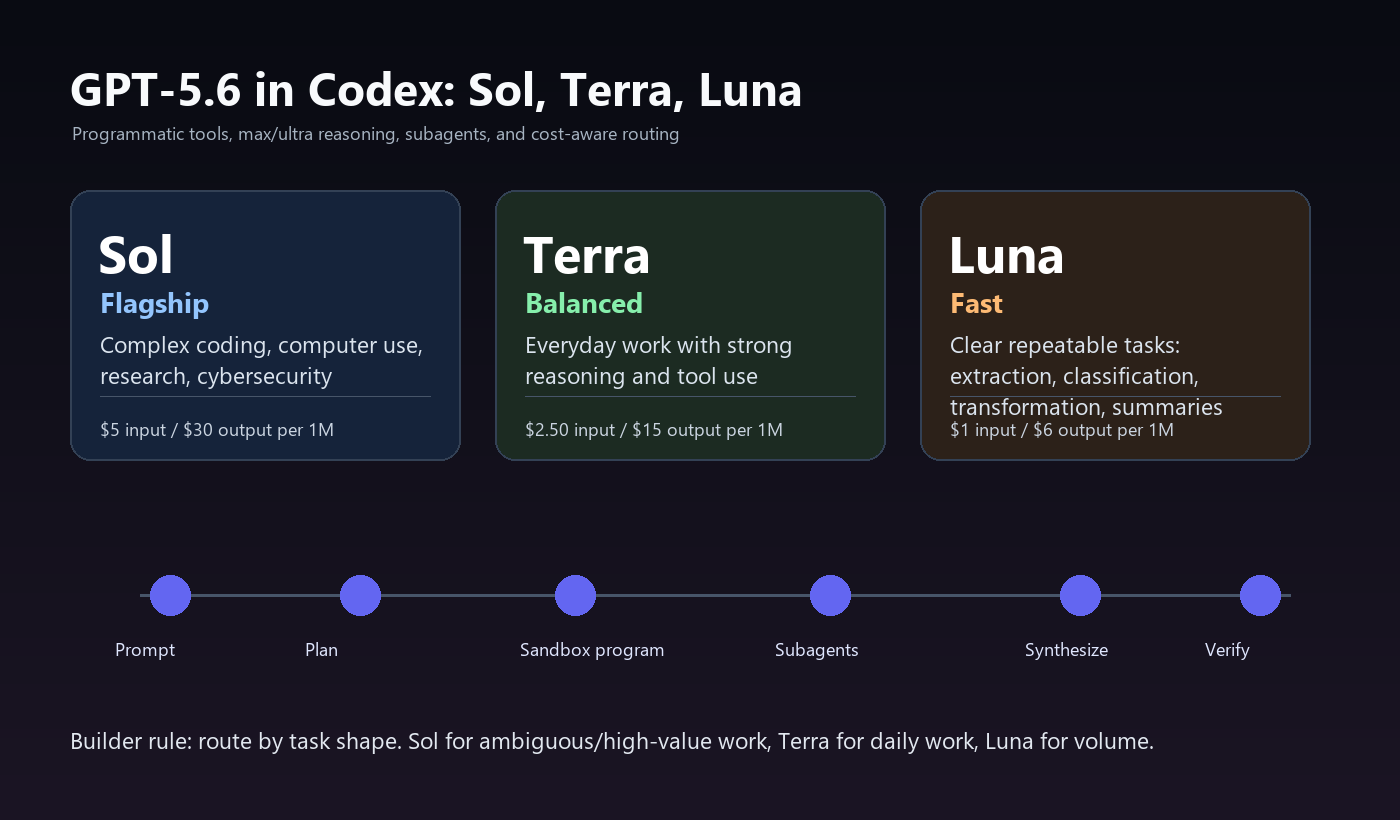
OpenAI is making the GPT-5.6 family easier to route.
| Model | Official role | Use it for | API pricing |
|---|---|---|---|
| GPT-5.6 Sol | Flagship model | Complex coding, computer use, research, cybersecurity, high-value knowledge work, polished deliverables. | $5 input / $30 output per 1M tokens. |
| GPT-5.6 Terra | Balanced model | Everyday work that needs strong reasoning and tool use without Sol-level depth. | $2.50 input / $15 output per 1M tokens. |
| GPT-5.6 Luna | Fast, affordable model | Clear repeatable tasks: extraction, classification, transformation, structured summaries, simple agents. | $1 input / $6 output per 1M tokens. |
My recommended default: start with Sol for ambiguous work, then demote proven repeatable workflows to Terra or Luna once you know what good output looks like.
Programmatic Tools
The Asterism video calls out Programmatic Tool Calling because it changes the cost and context shape of tool-heavy work.
In normal tool calling, tool results often bounce back into the model context. That is fine for simple tasks, but noisy for workflows with lots of intermediate data. Programmatic Tool Calling lets the model write JavaScript to coordinate eligible tools in a sandbox, use loops and conditions, call tools in parallel, process large outputs, and return only the useful result.
Use it when code can safely do the middle work:
- Search many records and return the top matches.
- Deduplicate, rank, filter, or aggregate tool output.
- Run predictable dependent calls where later arguments come from earlier results.
- Collect test results and return a compact pass/fail summary.
- Process raw data before the model needs judgment.
Do not use it when every intermediate step needs fresh human approval, nuanced reasoning, native citations, or preserved artifacts.
Max And Ultra
The ChatGPT Learn model docs say higher reasoning can improve complex tasks but takes longer and uses more tokens. That should become a routing habit.
- Medium is the baseline for everyday planning and implementation.
- High and Extra High fit difficult multi-step work with tradeoffs.
- Max is for the hardest single-agent tasks where depth matters more than cost.
- Ultra is for work that can be split across subagents, such as research, art, sound, implementation, QA, and packaging.
Ultra is exciting, but it should not be the default. It can improve quality and wall-clock time on genuinely parallel tasks. It can also waste tokens when the task is small, vague, or not decomposable.
The Work OS Pattern
The Dan Shipper walkthrough is useful because it shows GPT-5.6 and Codex as a work operating system, not just a code editor.
The important patterns from the transcript:
- Card-based inbox. Email becomes cards with summaries, next actions, and draft replies.
- Feeds for work areas. Company updates, Slack messages, meeting notes, and life areas become repeatable feeds.
- Context compounds. The system learns what matters and updates policies/prompts based on what gets archived, answered, or escalated.
- In-app browser. Codex can work inside tools instead of only generating code outside them.
- Maintenance as product. The real software opportunity is not just one-shot building; it is building things that stay maintained.
That last point is the biggest business takeaway. If anyone can generate a first version, the durable value moves to maintenance, integration, context, taste, support, and trust.
Model Routing
The commentary video comparing GPT-5.6 with Fable 5 makes a useful point even if the exact rankings will vary by workflow: the harness matters.
A model inside a weak tool surface feels limited. A slightly cheaper or faster model inside a strong harness can finish more real work. For teams, that means model routing should include:
- The model capability.
- The tool harness.
- The context available.
- The approval and review gates.
- The cost per completed task, not just price per token.
A simple routing table:
| Task shape | Route | Why |
|---|---|---|
| Ambiguous, high-value, hard to verify | Sol with high, max, or ultra | You need judgment, planning, and verification. |
| Everyday implementation or review | Terra or Sol medium | Good balance of cost, reasoning, and tool use. |
| Clear repeatable structured tasks | Luna | Lower cost when success criteria are already known. |
| Parallel research or build streams | Sol Ultra or API multi-agent beta | Multiple independent workstreams can reduce wall-clock time. |
| Tool-heavy filtering and aggregation | GPT-5.6 plus Programmatic Tool Calling | Let code compress intermediate tool output before model judgment. |
What To Build First
The best first GPT-5.6 projects are not giant autonomous fantasies. They are small, useful, and measurable.
- Inbox cards. Convert unread email into summary, suggested reply, next action, and confidence.
- Weekly company feed. Slack, meeting notes, metrics, and blockers into a reviewed briefing.
- Maintenance badge. A tiny app that proves your product is alive, with tests and release notes.
- Repo review loop. Run GPT-5.6 on recent code changes and ask for risk, tests, and polish tasks.
- Internal dashboard Site. Pull metrics and notes into a hosted, reviewable internal dashboard.
- Document-to-deck workflow. Source folder, template deck, evidence table, and final slides.
The reason these work: each has inputs, outputs, review points, and a definition of done. That gives the agent a real target.
Watch-Outs
GPT-5.6 is strong, but teams should not confuse strength with permission.
- Benchmarks are not your workflow. Run evals on your repo, docs, customers, and tools.
- Ultra is expensive if the task is not parallel. Use it where subagents have clean lanes.
- Programmatic Tool Calling needs boundaries. Decide which tools can be called and what data can be processed.
- Computer Use needs approval gates. Keep publish, send, delete, payment, deploy, and external actions reviewed.
- Safety filters can create friction. OpenAI says GPT-5.6 applies stronger safeguards, especially around cyber and bio work.
- Maintenance is the product. One-shot builds are demos. Businesses pay for maintained systems.
The opportunity for builders is not to worship a model. It is to design better work systems around the model: context, permissions, subagents, tools, review gates, retries, fallbacks, and finished artifacts.
Sources
- OpenAI: GPT-5.6
- OpenAI: Previewing GPT-5.6 Sol
- OpenAI Deployment Safety: GPT-5.6 preview
- ChatGPT Learn: Models
- OpenAI API docs: Programmatic Tool Calling
- OpenAI API docs: Using tools
- OpenAI API docs: Latest model guidance
- Asterism official demo game
- Official video: GPT-5.6 builds Asterism in Codex
- Commentary video: ChatGPT 5.6 changed AI forever
- Workflow video: GPT 5.6 Sol with Dan Shipper
CTA: Do not switch every workflow to Sol Ultra. Build a routing table: Sol for ambiguous high-value work, Terra for daily execution, Luna for clear volume tasks, and Programmatic Tool Calling when code can compress the messy middle.