Direct Answer
Qwen3.8 Max is Qwen's new flagship for coding, professional work, multimodal agents, research, and long-horizon execution. The official release describes a 2.4-trillion-parameter Mixture-of-Experts model with 95 billion parameters active per token. More important than the scale is the product thesis: the model is trained to keep working through tool use, feedback, verification, and revision until it produces a usable deliverable.
The launch evidence is substantial but still first-party. Qwen reports a 16-day autonomous coding project, a five-day research reproduction, a 24-hour multimodal competition, a closed-loop chip-design run, hundreds of professional-work tests, and broad benchmark gains. Those cases show where Qwen wants the model to compete. They do not replace independent replication, cost-per-result measurement, or the missing open-weight files and license.
Watch the Official Launch Video
Official source credit: video and launch research by the Qwen team. This article also uses Qwen's official 3 August 2026 release article and reproduces selected first-party figures below with attribution. All benchmark and case-study numbers are labeled as Qwen-reported unless independently confirmed.
What Is Released, and What Is Still Promised?
| Component | Status on 3 Aug 2026 | What it means |
|---|---|---|
| Qwen3.8 Max hosted model | Available through QwenCloud | Teams can call qwen3.8-max through compatible APIs and supported coding assistants. |
| Max open weights | Promised for the following week | The files, model card, checksums, serving guidance, and license still need to be verified when published. |
| Qwen3.8 27B | Announced separately by Qwen | The smaller checkpoint is likely more relevant to workstation-scale local use, but it is not the model evaluated in the Max release article. |
| Open-source status | Not yet established in the strict sense | Open weights are valuable, but they are not the same as publishing training data, full training code, and every development artifact. |
Qwen calls this its first Max-class open-weight model, but the tense matters. The release article says the weights will arrive next week on Hugging Face and ModelScope. Until those artifacts appear, the correct description is hosted now, open weights announced. The existing hands-on Qwen3.8 Max review tracks this distinction and adds independent build results, cost observations, and local-memory arithmetic.
Architecture and Product Positioning
Qwen says Qwen3.8 Max builds on the Qwen3.5 architecture and scales to 2.4T total parameters with 95B active. The MoE design reduces the parameters used for each token, but the total model remains data-center scale. Active parameter count describes the compute path. It does not mean a local machine only needs to store 95B parameters.
The official Codex configuration advertises a one-million-token context window, text and image input, parallel tool calls, and three reasoning levels. The larger strategic shift is the word cowork. Qwen is not positioning the model only as a code generator. It is aiming at mixed workspaces where the agent must read documents, operate interfaces, write code, coordinate sub-agents, render deliverables, inspect the result, and continue when the first attempt is wrong.
| Official capability | Operational interpretation | Verification question |
|---|---|---|
| 2.4T MoE, 95B active | Frontier-scale hosted model with sparse routing | What are latency and accepted-result costs in your region and harness? |
| 1M context in the Codex example | Large repositories and document sets can fit | Does retrieval stay accurate near the end of a long task? |
| Low, medium, xhigh reasoning | Reasoning depth can be routed by task | Which effort level passes your checks at the lowest cost? |
| Text and image input | Visual inspection can join code and document work | Can the model detect and repair layout or spatial errors reliably? |
| OpenAI and Anthropic compatibility | Existing agent harnesses can be reused | Do tool calls, streaming, and long runs behave consistently in your harness? |
The Official Benchmark Picture
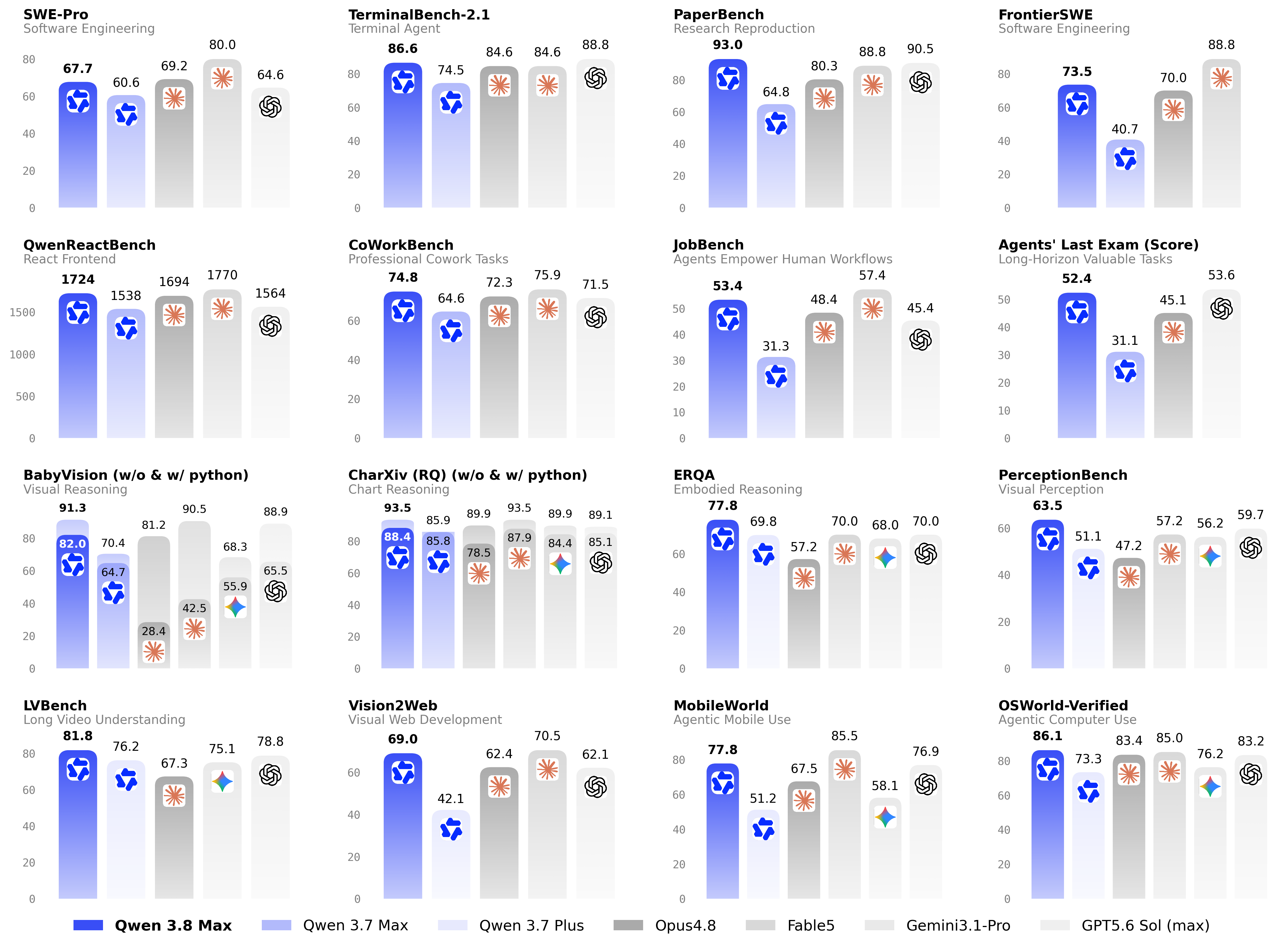
The chart is more nuanced than a universal “best model” claim. Qwen3.8 Max leads the displayed set on PaperBench and reports strong TerminalBench, QwenReactBench, visual reasoning, long-video understanding, and computer-use results. Claude Fable 5 remains ahead on several software-engineering tests, including SWE-bench Pro and FrontierSWE, while GPT-5.6 Sol leads the displayed TerminalBench result.
Qwen's methodology notes also show why harness discipline matters. Some results use Claude Code, some use Codex, and some use other specialized setups. Context limits, timeouts, temperatures, tool access, and benchmark corrections vary. The chart is a useful map of capability. It is not a controlled price-performance comparison for one production workflow.
Three Long-Horizon Coding and Research Cases
1. A self-evolving CLI harness
Qwen3.8 Max built oh-my-cli from an empty project and continued operating for about 16 days. Qwen reports 265 commits, 127 pull requests, and 151 issues by 30 July. The system normalized requirements into issues, leased work to agents, ran build, unit, end-to-end, and desktop-lifecycle checks, and routed failures back into repair work.
The repository is the most inspectable launch artifact because readers can examine the history instead of trusting a final screenshot. Still, commit count is not quality. The right follow-up is to audit merged changes, failure recovery, human intervention, test strength, and whether the project remains maintainable after the autonomous run.
2. Reproducing and extending a research paper
Given the paper Unified Data Selection for LLM Reasoning and GPU access, Qwen says the model worked for roughly 125 hours, wrote about 7,600 lines of code, took more than 1,100 actions, and ran 33 training rounds. It first reconstructed the paper's pipeline and six main findings, then tested 18 new ideas across four rounds. Qwen reports that the final method improved AIME24 by 2.7 points over the paper's method.
This case matters because the verifier was empirical. The model could not merely write a persuasive research memo; it had to produce code, train models, measure results, diagnose failed hypotheses, and decide what to try next. Independent reproduction should still check data leakage, statistical significance, compute budgets, and exact evaluation settings.
3. A 24-hour multimodal competition
In the WWW2025 Multimodal Dialogue Intent Recognition Challenge, the model built and refined a text-and-image ensemble under a 24-hour limit. Qwen reports 45 submissions, a final accuracy of 0.853, and a finish above 458 of 526 human teams. The score improved through repeated submission feedback, fine-tuning, weighting, and tie-breaking rather than one final guess.
How Qwen Trained for Cowork and Harness Portability
Qwen describes three linked reinforcement-learning systems. First, it scaled environments along task duration, workspace complexity, and harness variety. Second, it used a universal reward system that can combine executable checks, rubric-based judging of text and rendered visuals, and agentic inspection. Third, an online data balancer kept training batches spread across tasks, difficulty, workspaces, and harnesses.
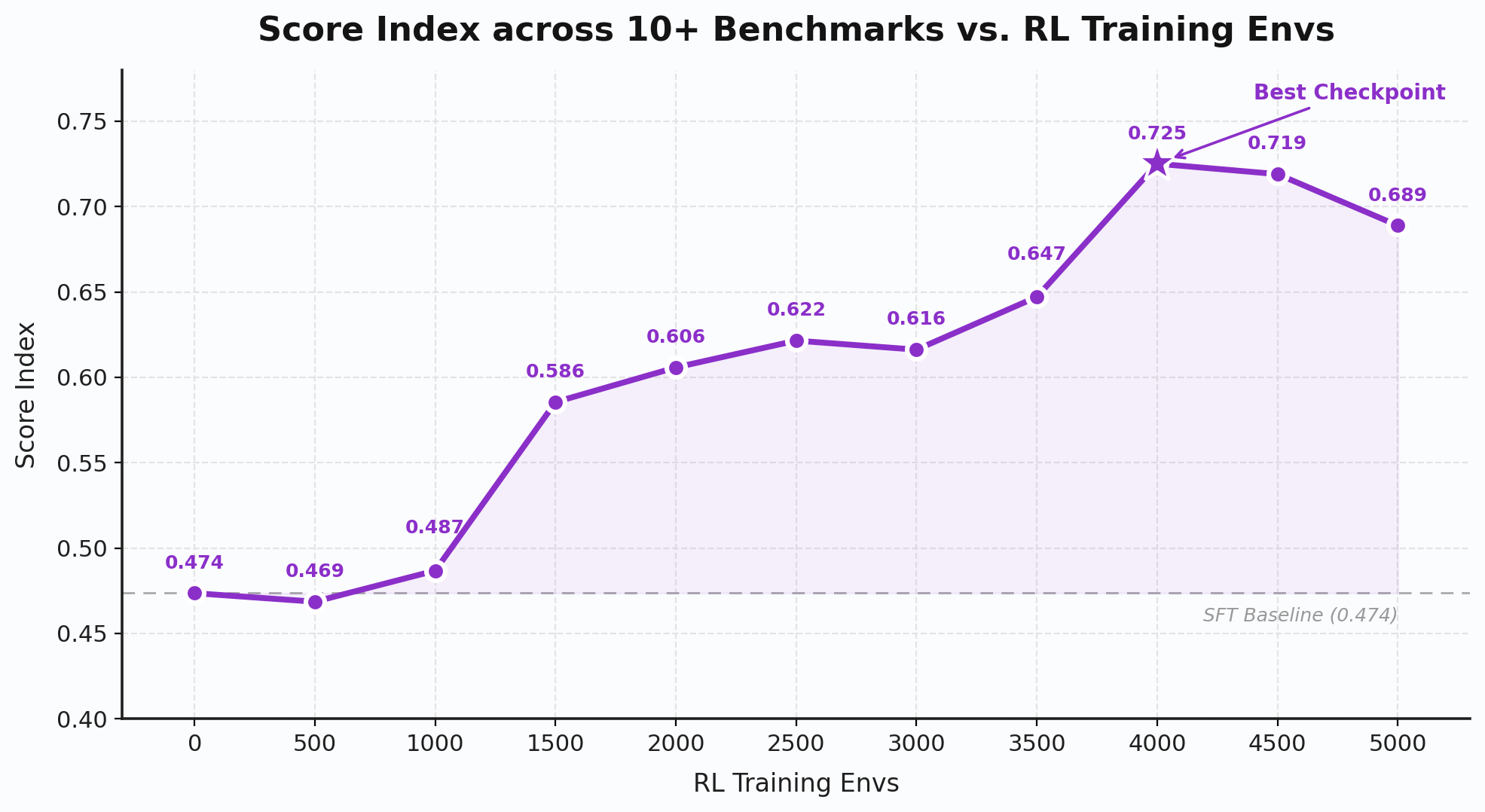
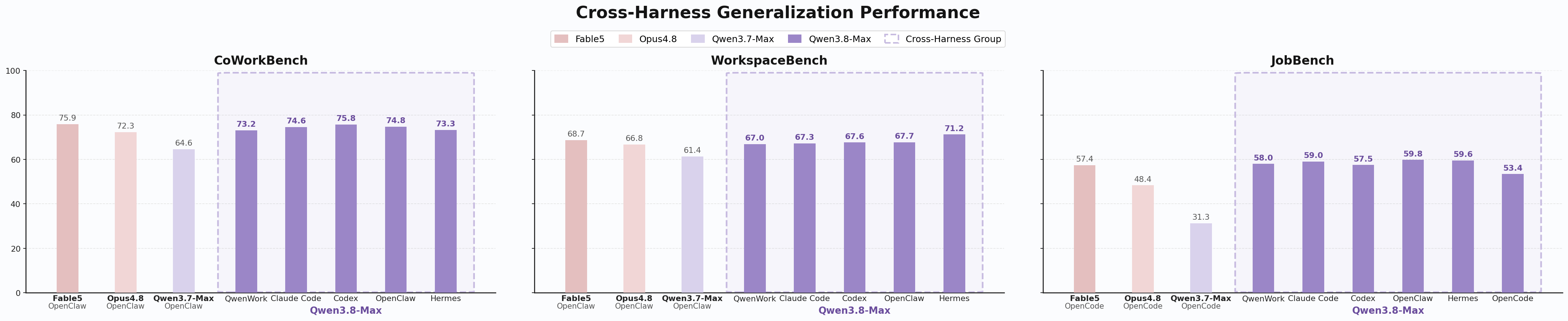
This is practically important. A model that only works inside one privileged harness is difficult to route and expensive to replace. Qwen's chart suggests reasonable portability, but it also shows several-point differences between harnesses. Teams should benchmark the model and the harness as one system rather than attributing every result to the model alone.
What “Cowork” Means in the Official Cases
Qwen says it stress-tested the model across hundreds of economically valuable professions. The showcased deliverables include a legal clause review, an eight-screen banking prototype, a costed restaurant menu, a browser-based structural model, a 3D rehabilitation visualization, and a basketball tactical report. These are vendor-run demonstrations, and several include time-saving comparisons that should be treated as illustrative rather than universal labor benchmarks.
| Showcase | Qwen-reported output | Production acceptance check |
|---|---|---|
| Compliance review | 1,284 clauses surfaced across hundreds of documents | Recall on a labeled sample, citation accuracy, privilege controls, lawyer sign-off |
| Banking prototype | Eight consistent interactive screens in one pass | Accessibility, interaction coverage, brand rules, responsive behavior, security review |
| Restaurant menu | 26 dishes with calories, provenance, and 33.8% food cost | Supplier prices, allergen rules, recipe feasibility, local labeling requirements |
| Structural model | Interactive 30-story seismic model | Independent engineering calculation, code compliance, unit and load-case validation |
| Sports analysis | About 8,400 possessions converted into a coaching profile | Event labeling accuracy, causal overclaim checks, coach review |
The launch also describes dynamic workflows for quantitative research: a single strategy-development loop plus roughly 330 sub-agents exploring factors through about 6,000 backtests. That demonstrates orchestration breadth. It does not make the resulting strategy investable. Backtest leakage, transaction costs, regime changes, capacity, and live forward performance remain separate questions.
Chip Design and a 365-Day Business Simulation
Closed-loop hardware optimization
The chip case is one of the clearest examples of “loop engineering” in the release. Inside a sandbox with Icarus Verilog, Yosys, cocotb, and OpenROAD, the model repeatedly edited, simulated, synthesized, and placed a cryptographic accelerator. Qwen reports that the design moved from 8,298 gates to 678 gates over about 500 turns and 71 evaluations. The physical layout shrank from 106 by 106 micrometers to 46 by 46 micrometers, while timing moved from a 4.46 ns violation to 0.66 ns positive slack at 500 MHz.
This is stronger than a diagram because the environment checked functional correctness and physical feasibility. It is still one vendor-designed task on one process design kit. Broader hardware claims need multiple architectures, independent review, power analysis, formal verification, and reproducible runs.
Continuous learning across a simulated year
Qwen's E-Commerce Bench simulates 365 operating days, 12 store types, about 600 suppliers, and 7,000 products, including fraudulent merchants and seasonal shocks. Qwen reports that Qwen3.8 Max finished with a balance of 416,252 yuan from 100,000 yuan in starting capital, 38% above GLM 5.2, after more than 2,000 interactions. The useful capability is not the fictional profit. It is whether the agent learns from negotiation and operating feedback without losing the year-end objective.
Multimodal Agents: Vision as a Feedback Loop
Qwen's multimodal argument goes beyond accepting an image. The model is meant to inspect intermediate work: page layout, object orientation, spatial relationships, animation quality, and application behavior. It can then revise the plan and repair the result. Qwen calls the combination of coding and GUI operation a Hybrid Agent: code handles scalable implementation, while interface interaction observes what the running system actually does.
The release introduces RecreationBench, where a model can interact with a black-box application on Ubuntu, macOS, Windows, Android, or the web and rebuild it without source access or internet access. It also announces Qwen-MM-Plugins, an extension layer for image and video processing, multimodal memory, visual tools, video editing, Blender, and CAD. Availability, license, supported harness versions, and safety boundaries should be checked when the package is published.
API, Reasoning Effort, and Coding Assistants
QwenCloud supports OpenAI-style chat completions and Responses APIs plus an Anthropic-compatible interface. The official guide documents integrations for Claude Code, Codex, Qoder CLI, Qwen Code, and OpenClaw. The hosted model ID is qwen3.8-max.
| Setting | Official guidance | Practical routing rule |
|---|---|---|
reasoning_effort: low | Optimize for speed and cost | Formatting, extraction, narrow edits, and tasks with strong deterministic checks |
reasoning_effort: medium | Balance accuracy and speed | Default pilot setting for normal engineering and document work |
reasoning_effort: xhigh | Thorough analysis; official default | Hard debugging, architecture, research reproduction, and long-horizon work |
preserve_thinking | Enabled by default | Test whether continuity helps enough to justify added context and cost |
Start with the official QwenCloud API guide. Keep the API key in an environment variable, use a separate project key with a hard budget, and begin in a non-sensitive repository. Compatibility reduces setup friction; it does not make every tool permission or response field identical across providers.
What the Official Release Does Not Prove
- Open weights are not downloadable yet. The announcement gives a near-term release commitment, not a file readers can inspect today.
- The final license is not in the launch article. Commercial, derivative, redistribution, and acceptable-use terms must be checked against the released checkpoint.
- One chart does not create a universal ranking. Benchmarks use different harnesses, context limits, tools, timeouts, and scoring methods.
- Autonomous duration is not autonomous quality. A ten-day run can produce valuable work or compound unnoticed mistakes. Inspect checkpoints, retries, tests, and intervention logs.
- Professional demos are not deployment studies. Legal, finance, healthcare, and engineering outputs still need domain controls and accountable review.
- Vendor cost is incomplete. API spend, harness compute, GPU experiments, storage, human review, and failed runs all belong in total cost.
- Open weights do not make Max a laptop model. MoE lowers active compute but the full 2.4T checkpoint remains enormous to store and serve.
A Seven-Day Evaluation Plan
- Day 1: choose one accepted-result metric. Use a real repository issue, report, browser workflow, or multimodal repair with a clear pass condition.
- Day 2: freeze the harness. Record the tool version, system instructions, permissions, repository commit, machine, region, and model settings.
- Day 3: write the verifier first. Add tests, browser assertions, source checks, image comparisons, financial constraints, or a structured review rubric.
- Day 4: compare reasoning levels. Run low, medium, and xhigh with the same budget and retry policy.
- Day 5: inject failure. Break an assumption, expire a credential, remove a file, or return a malformed tool response and measure recovery.
- Day 6: compare one alternative. Use the same harness and acceptance checks with your current frontier model.
- Day 7: decide with economics. Calculate accepted outputs per euro, wall-clock time, review minutes, regressions, and security exceptions.
Bottom Line
Qwen3.8 Max is a serious frontier release because its official story is built around long-running feedback loops rather than isolated prompts. The most compelling cases use external truth: tests and CI, training metrics, competition submissions, synthesis and layout tools, backtests, or visual inspection of a live application. That is the right direction for useful agents.
The release still needs independent scrutiny. The benchmarks are first-party, the Max weights were promised rather than available on launch day, and several professional claims require specialist validation. Use the official article to understand the architecture and training thesis, then read the independent ten-build review before choosing a production workload.
Official Sources and Further Reading
- Qwen Team: Qwen3.8-Max, A New Bar for Coding and Cowork
- Qwen: official 43-second launch video
- QwenCloud
- QwenCloud: first API call
- Qwen coding case: oh-my-cli repository
- Unified Data Selection for LLM Reasoning
- WWW2025 Multimodal Dialogue Intent Recognition Challenge
- QwenLM official GitHub organization
- Qwen official Hugging Face organization