 Local-First Studio · Built around a real YouTube channel
One brief,
seven arguments.
A local-first packaging studio for YouTube. One brief becomes seven genuinely different thumbnails, tested the way a viewer sees them, with the title scored against the winner.
Designed and built by João Queirós
Your video gets three seconds. Your thumbnail spends them.
Every screen in this trailer is the real studio, running a real episode from brief to shipped pair.
What "local-first" means here: the studio runs on the creator's own machine. Projects, briefs, reference photos and generated images live in ordinary folders on their disk, and the prompt pack is markdown any image generator can read. Nothing is locked into this app, and there is no account to create.
What is Thumbnail Studio?
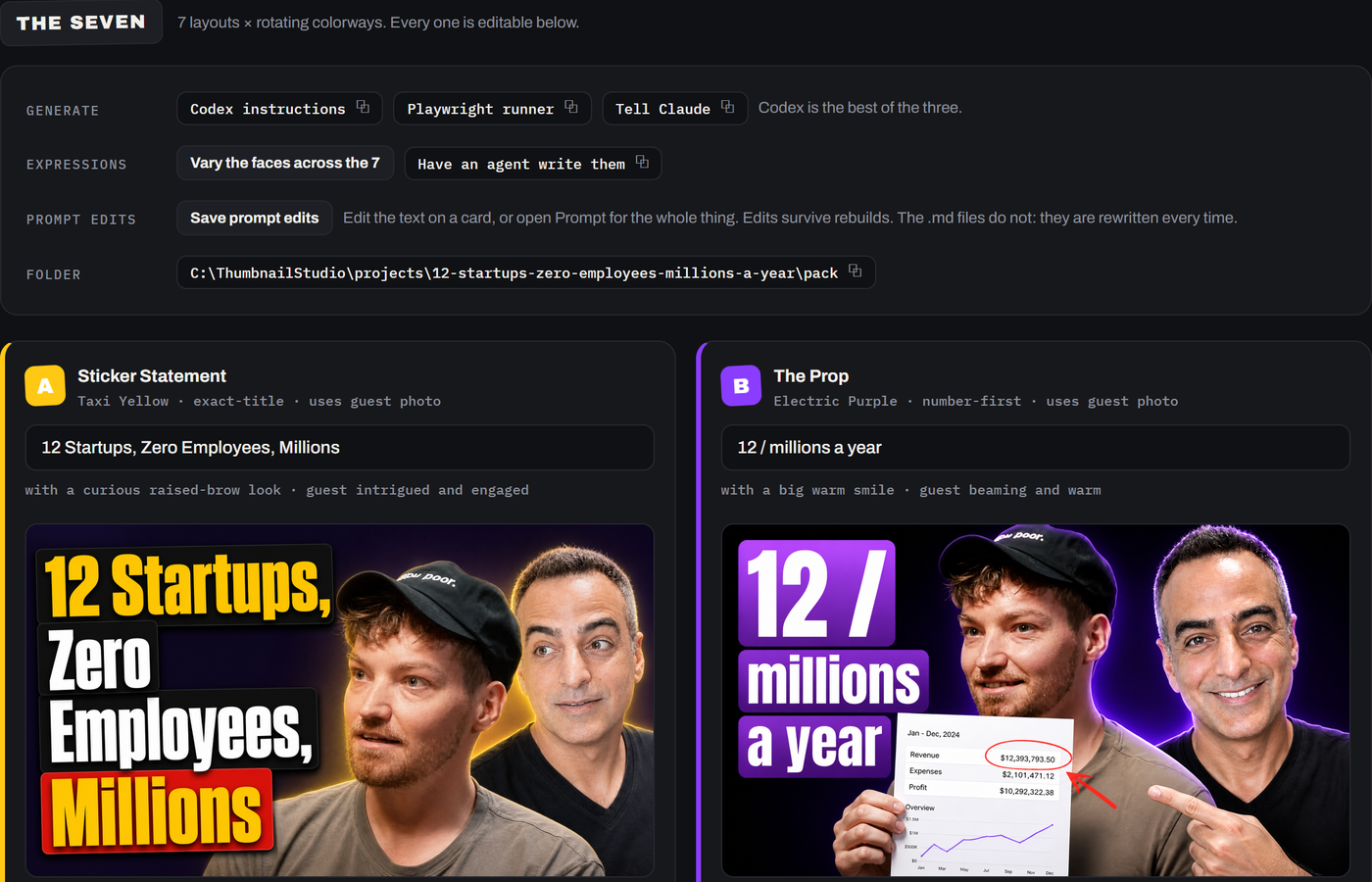
Thumbnail Studio turns a single video brief into seven thumbnail options built on seven layout archetypes across seven colorways, written out as editable prompts any image generator can run. It then judges them the way an audience does: head to head duels, the candidate hidden inside the creator's real channel feed, and a lab that shrinks every option to search size and flags text that dies there. Finally it scores each candidate title against the winning thumbnail and re-cuts the winner when the title moves on.
What was broken.
A YouTube video is judged in about three seconds, and almost all of that judgement lands on the thumbnail. Yet packaging is usually the last thing that happens: one image, made in a hurry, after the real work already felt finished. There is nothing to compare it against, so whatever gets made is what ships.
The tools on offer do not help with the actual problem. Prompt boxes return variations of the same idea rather than genuinely different arguments for the click, and none of them show what a thumbnail looks like at the size people really see it, sitting in a feed next to everything else competing for the same tap. The title is treated as a separate job entirely, written later, by someone looking at a text field instead of the image it has to work with.
What was built.
Thumbnail Studio treats packaging as a workflow with six stages rather than a single prompt. A brief becomes seven options built on seven distinct layout archetypes, each in its own colorway, with the host and guest expressions varied deliberately so the set argues seven different ways instead of seven shades of one way. The prompts are written to disk as plain markdown, so the creator can hand them to Codex, run a scripted generator, or paste them by hand: the studio does not care who made the pixels.
Choosing is treated as its own discipline. Options meet head to head in an arena, hide inside the channel's real feed, and shrink to search size where the lab flags text that stops being readable. Only then does the title arrive, and it is scored against the winning thumbnail on a roughly fifty percent word overlap rule: the thumbnail grabs, the title completes, and full overlap wastes the second hook. When the title moves on afterwards, a final round re-cuts the winner in new words or a new colorway rather than starting the packaging over.
Six stages, always in this order.
One lesson per stage.
About a minute each, captioned, recorded off the real studio. Open only the one you need; videos stay unloaded until you choose to play them.
 Lesson 01
Start thumbnail-first: the brief, the moods, and seven prompts in one click
Lesson 01
Start thumbnail-first: the brief, the moods, and seven prompts in one click
 Lesson 02
Generate the seven: the pack is files on disk, and any generator can read it
Lesson 02
Generate the seven: the pack is files on disk, and any generator can read it
 Lesson 03
Test and choose: duels, the real feed, and 168 pixels
Lesson 03
Test and choose: duels, the real feed, and 168 pixels
 Lesson 04
The title and the final round: the fifty percent rule, measured
Lesson 04
The title and the final round: the fifty percent rule, measured
 Lesson 05
Ship it: the social pack, the shipping row, and one download
Lesson 05
Ship it: the social pack, the shipping row, and one download
Andrew Warner appears with his permission. Thumbnail Studio was not commissioned by him: the thumbnails throughout this page are demonstration artwork based on episodes of his channel, The Next New Thing, and feature those episodes’ guests. No affiliation or endorsement is implied.
See it in action.
Click through the finished project.
A read-only build with a completed video in it. Walk the seven, run the arena, score a title against the winner and open the final round. Generating and saving are switched off; everything else works.
Open the live demo →Built with.
What changed.
The numbers describe the system, not a promise about anyone's channel. Seven is the size of the option set, not a claim about which one performs; the fifty percent figure is the overlap the title scorer aims for and reports in words as well as a number; 168 pixels is YouTube's search thumbnail width, which is where most text quietly fails. The thirty checks run the whole pipeline against a live studio on a scratch project and assert the invariants that kept breaking during the build: seven distinct expressions, no two consecutive variations sharing a mood, no fabricated figures in a prompt, and a guest never described as the host.
Seven arguments
for the click.
The product page carries the trailer, all five field guide lessons, and an arena you can play against the studio's own winner.