One video in,
three platforms out.
Automated content distribution system that converts YouTube music videos into 60-second vertical clips and posts them across TikTok, Instagram Reels, and Pinterest via Buffer API with platform-specific captions and hashtags.
What is Tidesstunes Social Pipeline?
The Tidesstunes Social Pipeline is an automated content distribution system built for the Tidesstunes music project (relaxing piano and ocean music). It downloads YouTube videos, encodes the best 60-second segment into vertical 9:16 clips, uploads to Cloudinary CDN, then distributes across TikTok, Instagram Reels, and Pinterest via Buffer's API with platform-specific captions, hashtags, and formatting. 17 videos processed, 39+ posts queued across 3 platforms.
What was broken.
Tidesstunes publishes relaxing piano and ocean music on YouTube. Every new video needs to reach TikTok, Instagram Reels, and Pinterest to grow the audience. Each platform has different requirements: vertical 9:16 format, different caption lengths, different hashtag strategies, different posting conventions.
The manual version of this workflow takes 30+ minutes per video. Download from YouTube, open a video editor, find the best 60-second segment, export at 9:16, then log into each platform separately, write platform-specific captions, add the right hashtags, post. Multiply by 17 videos and that is an entire day of repetitive work that adds no creative value.
Scheduling tools solve the posting part, but not the conversion part. They do not download from YouTube, do not encode to vertical format, do not select the best segment, and do not generate platform-aware captions. The gap is the full pipeline from source video to posted content.
What was built.
The system is a three-stage pipeline. Stage one handles source acquisition and encoding: yt-dlp downloads the YouTube video, FFmpeg selects the best 60-second segment (not the first 60 seconds, but the musically strongest section) and re-encodes it to 9:16 vertical format optimised for mobile viewing.
Stage two handles cloud hosting: each processed clip uploads to Cloudinary CDN, which provides the public URL that Buffer needs for posting. Cloudinary handles format optimisation and delivery.
Stage three is distribution: the Buffer API receives each clip with platform-specific metadata. TikTok gets short, hashtag-heavy captions. Instagram Reels get slightly longer captions with engagement hooks. Pinterest gets keyword-rich descriptions optimised for search discovery. Rate limiting and retry logic prevent API throttling across batch runs.
Architecture in plain English.
See it in action.
Walk through the full pipeline: selecting YouTube videos, analysing audio segments, encoding vertical clips, uploading to Cloudinary, generating platform-specific captions, and queuing posts across TikTok, Instagram Reels, and Pinterest.
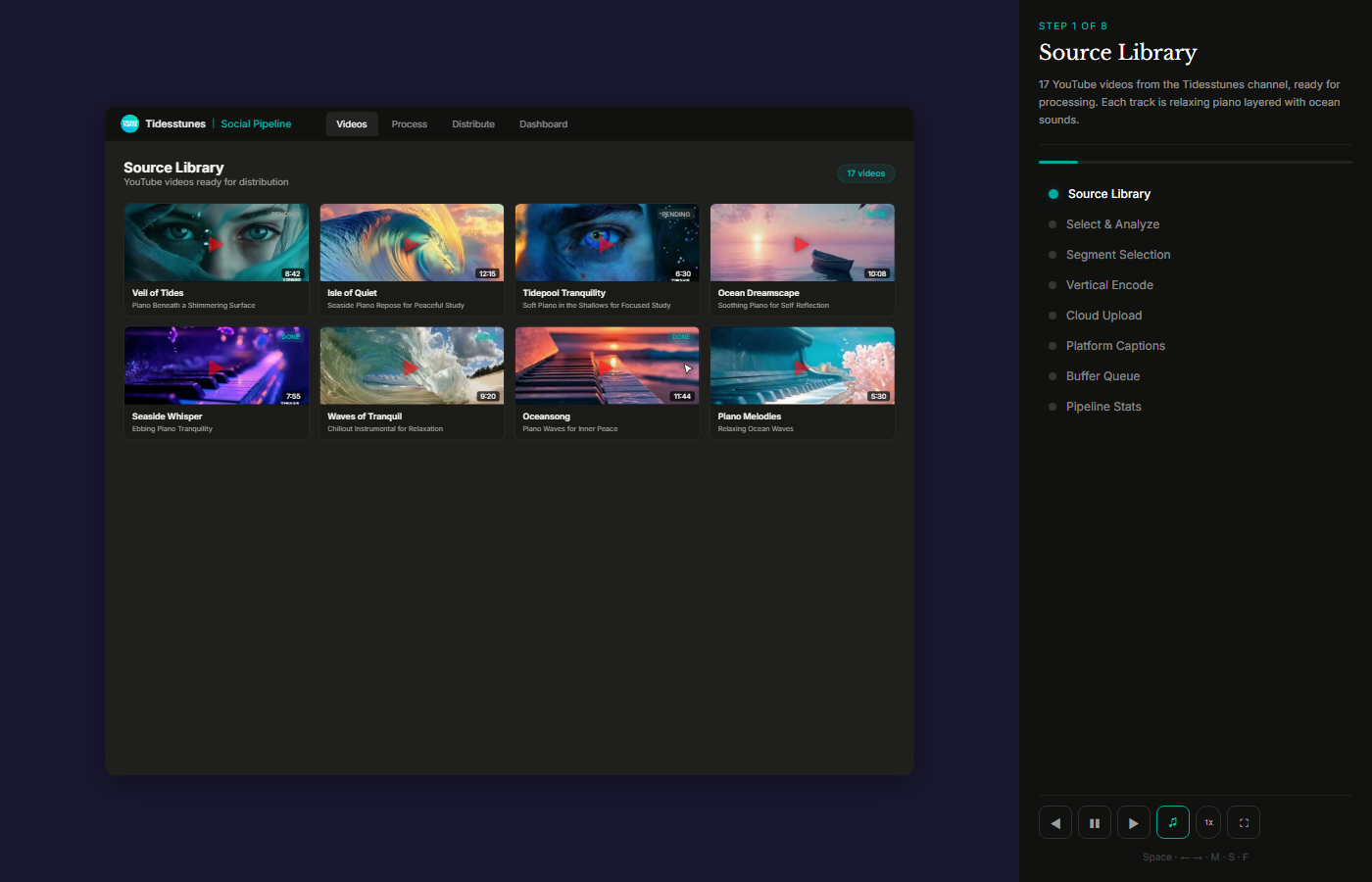
Source video enters, three platform-ready posts come out. Every step is automated.
Each platform receives tailored content. Same video, three different posts.
Built with.
What changed.
The biggest win is not speed but consistency. Every video now reaches all three platforms with properly formatted content instead of being posted to one and forgotten. The platform-specific caption generation means each post reads native to the platform it appears on, not like a cross-posted afterthought.
Want a system
like this one?
Book a free 30-minute call. We map your situation, scope a similar build, and agree on a fixed quote before anything starts.
Book Free 30-min Call