Direct Answer
The strongest idea in Corey Ganim's AI services playbook is not the promise of $5,000 to $10,000 in 30 days. It is the offer architecture: give a business one useful diagnosis for free, sell a deeper fixed-scope assessment, and offer ongoing implementation only after the client has seen your judgment and the work has earned trust.
The operating rule underneath all three offers is equally useful: audit the process, optimize it, and only then automate it. That sequence turns "AI consulting" from a vague technology pitch into a concrete service. The revenue, conversion, profit-margin, and effective-hourly-rate numbers in the video are Corey's self-reported results and marketing claims. They are not typical-outcome data, audited financials, or a promise that another consultant will reproduce them.
Credit: The offer ladder, AOA method, report sequence, AI Concierge model, scripts, and creator case-study figures come from Corey Ganim. Watch the original video, follow Corey on X, or see his LinkedIn profile.
Source Note
This article uses the supplied transcript and Corey's video as the primary creator source. His current AI Operator Academy page repeats the Audit, Optimize, Automate method and identifies Corey as its founder. It also reports 15-plus paid assessments, five active concierge retainers, roughly $30,000 in AI-services revenue for the year, and an $8,000 monthly recurring revenue launch. The same page expressly says its income figures are individual experiences, are not typical, and are not promises of earnings.
The product and risk claims were checked against current primary sources. Anthropic confirms that Claude Projects can hold separate files, instructions, and knowledge, while Claude Skills package reusable procedures and can operate across connected apps. Anthropic's small-business guidance also keeps existing permissions in force and places approval before consequential actions such as sending, posting, or paying. The FTC's June 2026 earnings-claims guidance warns that unusual success by a few people does not support claims that others will probably earn the same amount.
Corey's AI Services Resource Library and report template are third-party email-signup pages. The JQ AI SYSTEMS Responsible AI Tools Assessment is a separate original companion, opens directly, and does not require an email address.
Link Map
| Resource | Status | Use it for |
|---|---|---|
| The Ultimate AI Services Free Course | Primary creator source | Corey's complete offer ladder, AOA method, report, concierge backend, client acquisition, and launch plan. |
| Corey Ganim on YouTube, X, and LinkedIn | Creator credit | Corey's original publishing channels and professional profile. |
| AI Services Resource Library | Creator resource, email signup | The collection Corey links from the episode. Review its terms and expect an email opt-in. |
| AI Tools Assessment Report Template | Creator resource, email signup | The report template route shown in the video; it redirects to a Kit signup page. |
| Responsible AI Tools Assessment HTML | Free original companion, no signup | A fillable and printable JQ AI SYSTEMS edition with evidence, costs, owners, permissions, risks, assumptions, and review dates. |
| AI Operator Academy | Corey's commercial program | The AOA method, assessment and concierge training, member resources, pricing, guarantee terms, and income disclaimer. |
| SaneBox | Tool example | Corey's most frequently prescribed example for email overload. Verify current pricing, permissions, privacy, and client fit before recommending it. |
| Futurepedia and There's An AI For That | Discovery directories | Find candidates, then verify each product on its official pricing, security, privacy, integration, and support pages. |
| Claude for Small Business | Official product guidance | Connectors, ready-to-run workflows, permission inheritance, training defaults, and approval before consequential actions. |
| Claude Projects and Claude Skills | Official documentation | Separate client context from reusable task procedures and understand current availability. |
| Notion permissions guidance | Official access guidance | Use least privilege for a client hub and avoid workspace-wide access. |
| Jotform encrypted forms, Fathom, and Voxer | Operations tools | Intake, consented meeting capture, and bounded asynchronous support. Confirm the client's data and regional requirements. |
| FTC earnings-claims guidance and testimonial Q&A | Official marketing guidance | Substantiate income claims, distinguish exceptional from typical results, and disclose incentives for testimonials. |
| The $999 AI Tools Assessment | JQ AI SYSTEMS deep guide | Use the discovery script, analysis prompt, report structure, privacy controls, and fully loaded unit economics. |
The Three-Offer Ladder
Corey's ladder moves from one problem, to several problems, to ongoing implementation. The shape is sound because the client's commitment grows only after evidence arrives.
| Offer | Core promise | Deliverable | Responsible boundary |
|---|---|---|---|
| Free mini assessment | Find one operational pain and one plausible response. | Two short conversations, one recommendation, its cost, and a first step. | No implementation, broad system access, invented savings, or surprise pitch. |
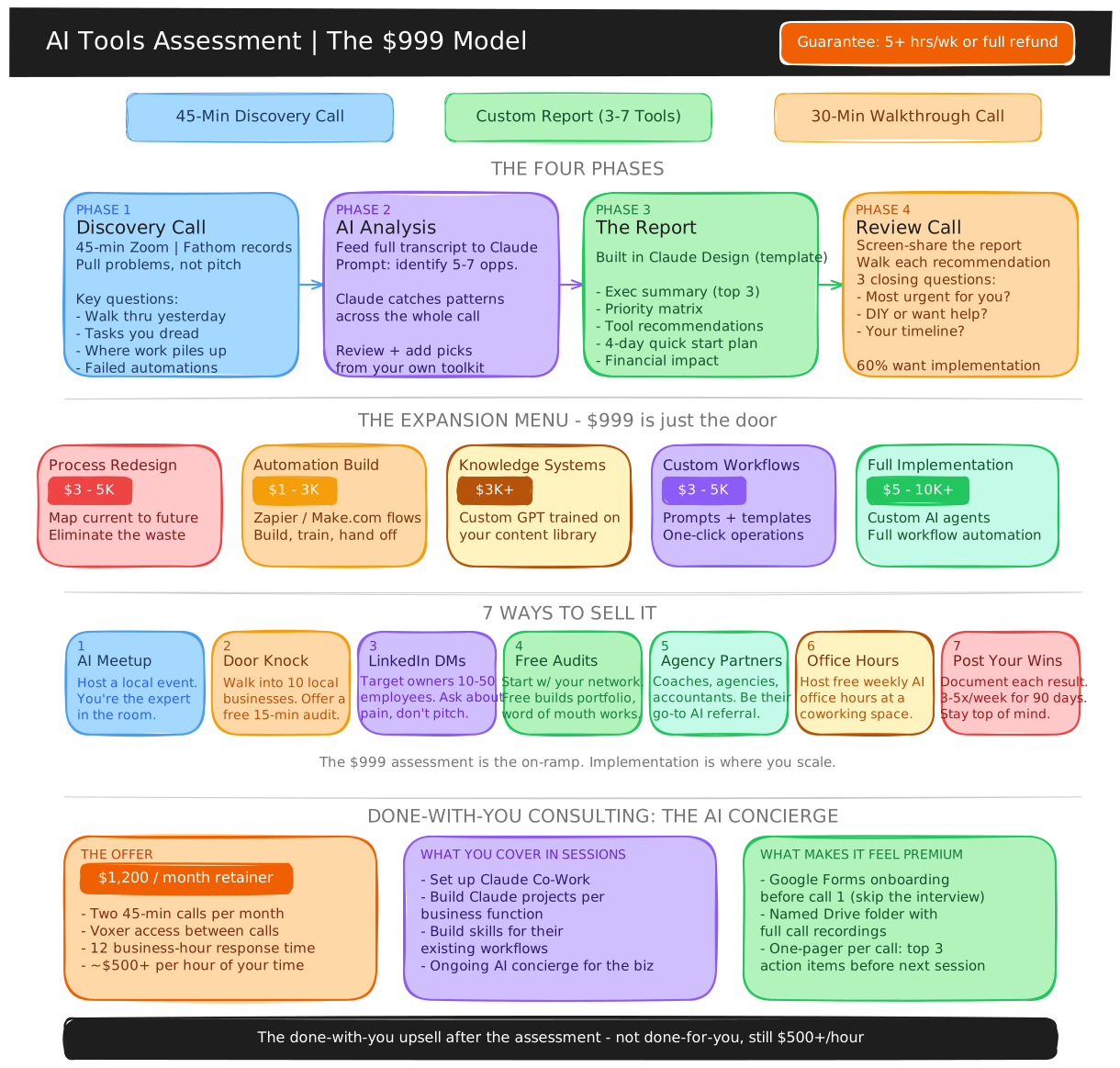
| $999 AI Tools Assessment | Diagnose three to seven pains and prioritize proportional solutions. | A 45-minute interview, checked research, six-part report, and 30-minute review. | Fixed scope, consented data use, documented assumptions, and no guarantee beyond evidence. |
| $1K-$2K AI Concierge | Help the owner adopt Cowork and turn proven processes into reusable skills. | Two 45-minute working calls per month, client hub, action log, and bounded support. | Explicit support hours, permissions, client cap, exclusions, and separate implementation quotes where needed. |
The phrase "every rung sells the next" needs a careful interpretation. The free offer can make the paid offer visible, and the paid assessment can uncover implementation work. But the diagnosis becomes untrustworthy if every finding conveniently points to the consultant's retainer. Separate the recommendation from the sales decision, disclose affiliate relationships, and give the client a genuine do-it-yourself path.
AOA and the Three ROI Levers
AOA means Audit, Optimize, Automate. The audit records the workflow as it actually exists. Optimization removes handoffs, duplicate entry, unnecessary approvals, and obsolete steps. Automation is last, after the shorter process has an owner, examples, exception handling, and a success test.
- Audit: observe the person doing the work from trigger to finished output. Record systems, inputs, decisions, exceptions, permissions, time, volume, and failure costs.
- Optimize: remove work that should not exist, combine duplicate steps, clarify ownership, standardize inputs, and define what still needs human judgment.
- Automate: choose the smallest reliable mechanism. That may be a checklist, a template, a SaaS tool, Cowork, a Claude skill, or deterministic automation. AI is not automatically the answer.
Corey then asks every recommendation to move at least one of three levers: effectiveness means more revenue or better conversion; efficiency means less time or lower operating cost; quality means a better product, service, or customer experience. This is a useful filter, but it is not an ROI calculation until the baseline, measurement period, full cost, and confidence range are written down.
The Free Mini Assessment
Corey's mini assessment uses a 15-minute interview to identify one bottleneck, a short research step, and a second short conversation to prescribe one tool or workflow direction. The three routing buckets are practical:
- High-frequency, high-friction problem: look first for an appropriate off-the-shelf tool.
- Judgment-heavy task: consider a bounded Cowork workflow with human approval.
- Company-specific repeated process: audit and optimize it before considering a custom Claude skill.
His highest-leverage question is simple: If you could fix one problem in the business, what would it be? Follow it with evidence questions: how often does it occur, who does it, how long does it take, what does failure cost, and can the client show a redacted example?
A Responsible Warm-Contact Message
Hi [name]. I am piloting a narrow AI tools assessment for [type of business].

In a 15-minute call, I will ask how one repeated task works and research one
realistic way to reduce the friction. The recommendation may be an AI tool,
a normal software feature, or a process change. There is no obligation to buy
anything, and I will not ask for account access during the call.

Would this be useful? If not, no problem.
This version avoids pretending that the consultant already knows the answer. It also avoids the hidden bargain of "free advice in exchange for permission to pitch." If the paid assessment is relevant after the recommendation, state it plainly and let the prospect decide without urgency language.
The $999 Assessment
The paid assessment expands the diagnosis to three to seven bottlenecks, although Corey says four or five recommendations is often the useful middle. The six-part report shown in the video is:
- Executive summary: main pains, expected outcome, estimated weekly time returned, and primary ROI lever.
- Effort-versus-impact matrix: quick wins, major projects, low-value distractions, and ideas to reject.
- Quick-win summary: each observed problem connected to one proportionate response.
- Recommended solutions: tool, use case, price, setup effort, expected benefit, assumptions, owner, and risk.
- Four-day starting plan: one small implementation step per day rather than a long transformation backlog.
- Financial impact and next steps: value range, software cost, confidence, measurement plan, and optional major projects.
The transcript calculates time saved by multiplying the client's self-reported hourly value by estimated hours returned. That can be a useful opportunity estimate, but it is not cash profit. An owner's freed hour creates value only if it is actually redeployed into useful work. Present conservative, expected, and optimistic scenarios instead of one precise number.
The AI Concierge Retainer
Corey's concierge is a done-with-you adoption service, not a managed automation agency. The client receives two 45-minute working sessions each month. The first session configures the working environment and gathers context. Later sessions observe one manual process, run AOA, and turn only the stable portion into a reusable workflow or skill.
Between calls, the episode offers Voxer access with a 12-business-hour response promise. Corey reports only four out-of-call messages across five clients during the first three months and caps his own roster at six. Treat that as an early case study. Support behavior changes by client, industry, onboarding quality, and how broadly "unlimited" is interpreted.
| Retainer element | Define before the sale |
|---|---|
| Two working calls | Length, booking window, rescheduling, rollover, participants, recording consent, and preparation required. |
| Asynchronous support | Business hours, channel, response target, monthly fair-use boundary, emergencies excluded, and what becomes paid project work. |
| Claude Project | Client owner, files allowed, retention, access list, data classification, and offboarding export or deletion. |
| Notion client hub | Page permissions, call logs, approved recordings, action owners, decision history, and review cadence. |
| Skill building | Inputs, outputs, examples, failure modes, review gate, version history, and acceptance test. |
| Renewal | Monthly outcomes, adoption evidence, open risks, completed assets, and a clear stop or handoff option. |
The Four Claude Skills Behind the Backend
The most reusable part of the episode is the concierge operating system. Corey shows one Claude Project per client, six context files, a shared Notion hub, and four skills that reduce repetitive administration.
| Skill | Input | Output | Human check |
|---|---|---|---|
| Intake to project files | Approved Jotform intake | Process inventory, client profile, time sinks, goals, tool stack, glossary, and project instructions. | Remove unnecessary personal data, verify every fact, and keep each client isolated. |
| AI Concierge call update | Consented transcript and call metadata | Notion session log with recording, recap, takeaways, action items, and assets built. | Confirm commitments, owners, dates, links, access, and what is safe to share. |
| AI Concierge follow-up email | Reviewed call summary | A short email describing outcomes, actions, and the client-hub link. | Approve the wording and recipient before sending. Do not let the model invent completed work. |
| AI Concierge post-call orchestrator | Reviewed transcript and session record | Runs the update and email-draft skills in sequence. | Stop at draft. Orchestration should not remove the final review gate. |
Anthropic's documentation makes the architecture distinction useful: Projects hold persistent background knowledge for a client; Skills hold task-specific procedures that can be reused. That means client facts should not be buried inside a generic skill, and one client's examples should never leak into another client's workspace.
A Minimal Post-Call Contract
Inputs
- Approved transcript or notes
- Client project instructions
- Existing action log

Produce drafts only
1. Three factual outcomes from the call
2. Action item, owner, and due date
3. Assets created or changed, with links
4. Risks, blockers, and decisions still open
5. A concise follow-up email linking the client hub

Rules
- Never invent a completion, owner, date, metric, or link.
- Flag uncertain statements for review.
- Do not send email or change permissions.
- Do not expose information from another client.
- Wait for human approval before publishing either output.
Honest Unit Economics
Corey calls the assessment and concierge 99.8 percent net-margin offers because a $20 Claude subscription is the visible software cost. That is not net-margin accounting. It excludes the founder's labor, sales time, research, preparation, support, administration, payment fees, other tools, insurance, refunds, taxes, churn, and empty capacity.
| Example: $1,500 monthly retainer | Hours |
|---|---|
| Two 45-minute client calls | 1.5 |
| Preparation and workflow research | 1.5 |
| Post-call review and documentation | 1.0 |
| Asynchronous client support | 1.5 |
| Sales, billing, administration, and unallocated capacity | 2.5 |
| Fully loaded monthly time | 8.0 |
| Effective rate before software, fees, insurance, and tax | $187.50/hour |
That is still attractive for a small, well-scoped advisory service. It is simply different from billing $1,000 for every hour worked. Use this formula:
effective hourly rate =
(collected revenue - software - fees - refunds - direct costs)
/ (delivery + sales + prep + support + admin + idle capacity hours)
The same evidence standard applies to the launch funnel. Corey reports that 10 warm messages can produce about six meetings and one or two paid assessments, that three free assessments should produce at least one paid assessment, and that his first five concierge prices rose from $1,200 to $2,000 with no rejection. These are creator-reported observations from a small, warm-network sample, not forecast inputs for an unknown consultant.
The FTC advises sellers and promoters of money-making opportunities to substantiate earnings claims and warns that unusually successful outcomes do not establish what a typical participant is likely to earn. "Results may vary" is not a substitute for evidence. This article therefore treats the $5,000-$10,000 month, $1,250 hourly rate, 99.8 percent margin, and conversion figures as claims to inspect, not promises to repeat.
Finding the First Clients Without Becoming Spammy
Corey recommends four accessible routes: a warm network, a local AI meetup, direct visits to suitable local businesses, and referral partnerships with accountants, insurers, agencies, or other trusted advisers. The durable principle is proximity to a real workflow, not message volume.
- Warm network: invite a small number of relevant owners to a research-first pilot. Do not imply guaranteed savings.
- Local workshop: teach one bounded workflow, disclose any commercial follow-up, and contact only people who agreed to hear from you.
- Direct local outreach: research the business first, respect staff and no-soliciting policies, and leave immediately when the answer is no.
- Professional partners: define referral disclosure, client ownership, confidentiality, and whether compensation exists.
If an early assessment is free in exchange for feedback, ask for an honest review, not a positive one. Obtain written permission before using the client's name, logo, quote, screenshots, metrics, or workflow as a case study. The FTC's testimonial guidance prohibits fake or false testimonials and requires material incentives to be handled transparently.
A Safer 30-Day Launch Plan
The goal of month one should be a validated offer and one credible delivery, not a promised income number.
- Week 1, define: choose one industry and one workflow you understand. Write the free-assessment boundary, consent language, tool-research checklist, paid scope, refund terms, and data-retention rule. Invite 10 relevant warm contacts without forecasting response rates.
- Week 2, diagnose: run up to three mini assessments. Deliver one useful recommendation each. Record time spent, questions you could not answer, and whether the client implements the first step.
- Week 3, prove: deliver one paid or clearly labelled pilot assessment using the six-part report. Verify every vendor claim on official sources, show assumptions, and measure one small result. Do not build the voice agent before you can run the interview well yourself.
- Week 4, systemize: create one client project, a least-privilege hub, the intake-to-files skill, and a draft-only post-call workflow. Offer a month-to-month concierge only when the client has repeated work, an accountable owner, and enough value to justify the support.
What to Copy and What to Avoid
| Copy this | Avoid this |
|---|---|
| Audit, optimize, then automate. | Automating the client's first description of a broken process. |
| One narrow free diagnosis with a clear boundary. | Calling a sales call a free assessment while withholding the useful answer. |
| A paid report with costs, owners, assumptions, risks, and verification. | AI-generated tool lists presented as expert certainty. |
| One Project per client and reusable Skills for procedures. | Mixing client knowledge into generic skills or shared workspaces. |
| Draft-only post-call automation with human approval. | Automatically emailing invented summaries or changing client records. |
| Fully loaded unit economics and conservative forecasts. | Revenue divided only by call time and described as net profit. |
| Specific permission for recordings, transcripts, and case studies. | Using private calls, logos, or results as marketing by default. |
Bottom Line
Corey Ganim's full system is useful because it connects offer design to delivery design. The mini assessment demonstrates judgment. The $999 assessment turns several pains into a prioritized plan. The concierge helps the client adopt the plan and preserves an evidence trail through client projects, skills, and a shared hub.
The opportunity is not effortless money. It is a small, disciplined services business built around diagnosis, proportional recommendations, implementation support, and visible proof. The consultant earns recurring revenue only when the client keeps receiving outcomes they can inspect.
Sources
- Corey Ganim: The Ultimate AI Services Free Course | $0-$10K in 30 Days
- Corey Ganim on YouTube, X, and LinkedIn
- Corey Ganim: AI Services Resource Library
- AI Operator Academy: AOA method, program contents, pricing, guarantee, and income disclaimer
- Corey Ganim: AI Tools Assessment Report Template
- SaneBox, Futurepedia, and There's An AI For That
- Anthropic: Introducing Claude for Small Business
- Claude Help Center: What are Projects?
- Claude Help Center: Use Skills in Claude and Skills overview
- Notion: sharing and permission guidance
- Jotform: encrypted forms, Fathom, and Voxer
- Federal Trade Commission: Back up those earnings claims
- Federal Trade Commission: Consumer Reviews and Testimonials Rule Q&A
- JQ AI SYSTEMS: Responsible AI Tools Assessment companion