Direct Answer
Zero-click marketing does not mean giving up on websites, search, or conversion. It means making the content useful before the click, building trust across the places buyers already spend attention, and measuring whether that exposure creates demand rather than insisting that the final referrer deserves all the credit.
Amanda Natividad's MicroConf talk turns that shift into a founder operating system: publish native value on two or three audience channels, keep one owned channel strong, replace traffic with a layered outcome scorecard, publish evidence that search engines and LLMs can verify, and treat every content asset as a service with an internal client and a business job.
Watch Amanda Natividad's MicroConf Talk
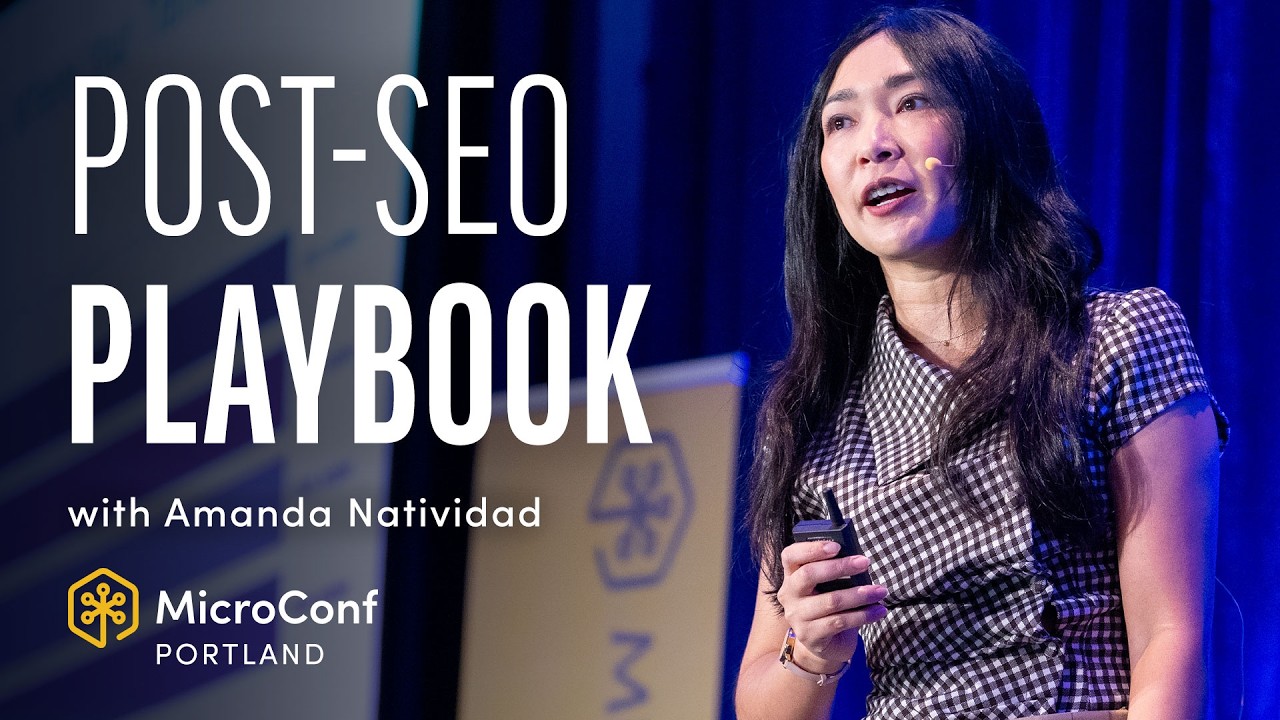
Talk credit: Amanda Natividad, founder of Zero Click Marketing and Chief Evangelist at SparkToro. Recorded at MicroConf US 2026 in Portland. The video owner has disabled third-party playback, so the poster opens the original YouTube video. Follow Amanda on LinkedIn.
Link Map
| Resource | Why it matters | Best use |
|---|---|---|
| Zero Click Marketing | Amanda Natividad and Rand Fishkin's current home for the framework | Principles, podcast, book, and updates |
| 2026 Google clickstream study | Updates the clickless-search baseline using Similarweb panel data | Understand the trend and its limits |
| Search Happens Everywhere | Maps search behavior across traditional search, commerce, social, and AI | Channel planning beyond Google |
| Dark social experiment | Shows how messaging and social referrals become misleading direct traffic | Interpret analytics with caution |
| Public evidence creates demand | Connects reviews, forums, third-party mentions, and AI citations | Build a credible public record |
| Content as a Service | Gives each asset an internal client, job, metric, and refresh rule | Replace the empty editorial calendar |
| Dropbox blackout study | Production evidence that attributed performance can diverge from causal lift | Design incrementality tests |
What Actually Changed
The old content playbook was easy to diagram: publish on your site, rank or distribute a link, collect a visit, then attribute the conversion to the last measurable touch. Every part of that chain is now weaker.
- Search answers more questions in the results. The query still happens, but the visit may not.
- Social feeds optimize for time inside the platform. A complete native post is often more distributable than a teaser whose main job is to send people away.
- LLMs summarize the public web. A buyer can learn the category, compare options, and form a shortlist before visiting a vendor.
- Private sharing hides the journey. Slack, WhatsApp, Discord, DMs, podcasts, and word of mouth can create demand that analytics later labels direct or search.
- Last-touch reporting rewards the demand catcher. Branded search frequently gets credit for a decision created by a social post, a peer recommendation, a webinar, or repeated exposure.
Amanda's buyer journey is closer to reality: a prospect sees a founder on LinkedIn, hears the person on a podcast, joins the newsletter, encounters a recommendation in a private Slack community, later searches the brand, and finally converts. Google captured the demand. It did not necessarily create it.
The Headline Claims, Checked
| Claim from the talk | What the source supports | How to use it |
|---|---|---|
| Nearly 60% of U.S. Google searches end without a click | The 2024 SparkToro/Datos panel reported 58.5%. A newer Similarweb/SparkToro panel reported 68.01% for the first four months of 2026. Panels, definitions, devices, and periods differ. | Treat the direction as strong evidence, not a universal constant for every query or market. |
| Only 360 open-web clicks per 1,000 U.S. Google searches | The 2024 study counted 360 clicks to non-Google, non-ad properties for every 1,000 searches. About 20% of clicked searches produced multiple result clicks. | Remember that searches, clicks, and unique visitors are not interchangeable. |
| 97.3% of U.S. Facebook post views went to posts without an external link | Meta's Q1 2025 Widely Viewed Content Report showed 2.7% of Feed views on posts with external links. That describes the observed content mix, not a controlled proof that inserting a link causes a 97.3% reach loss. | Test native posts and links separately; do not turn a descriptive statistic into a guaranteed algorithm rule. |
| No-link posts can reach about 10 times more people | SparkToro reports this as an observation from its own cross-platform testing, not a universal benchmark. | Use it as a hypothesis for your account, audience, format, and platform. |
| Traditional analytics misses private sharing | In SparkToro and Really Good Data's 1,113-visit experiment, all TikTok, Slack, Discord, Mastodon, and WhatsApp visits appeared as direct; other networks hid some referrals. | Add self-reported attribution and qualitative sales evidence instead of trusting channel rows alone. |
| Attributed ROAS can mislead budget decisions | Dropbox's 2026 IEEE Access study found major gaps between attribution and causal lift, reallocated about $25 million, and reported a 53% improvement in incrementality-adjusted portfolio LTV:CAC. | Use periodic holdouts or geo tests for large budgets; do not assume platform dashboards measure incrementality. |
There is a useful update to the talk's search mix as well. SparkToro and Datos' Q4 2025 desktop panel measured Google at 73.7% of searches across 41 major sites, traditional search engines at about 80%, commerce around 10%, social platforms 5.5%, and AI tools 3.2%. That does not make AI discovery unimportant. It means the practical strategy is search everywhere optimization, not replacing Google work with an AI-only plan.
The Five-Part Zero-Click Operating System
1. Build on rented land, deliberately
Publish native, complete ideas on the two or three platforms where your buyers already pay attention. A founder should not copy the same teaser and link everywhere. Rebuild the idea for the local format: text on LinkedIn, a useful answer in a community, a worked example on YouTube, or a short argument in a podcast.
Rented land is still rented. Keep source files, audience insights, and reusable assets in your own system. Never make one platform account the only record of your expertise or the only path to your audience.
2. Keep one owned channel strong
Amanda argues for email because it is direct, portable, and not dependent on an algorithmic feed. The website still matters too: it holds canonical facts, deeper explanations, case studies, tools, pricing, conversion paths, and the public evidence that search systems and LLMs can retrieve.
The clean division is: social earns attention, email maintains the relationship, and the site carries proof and conversion.
3. Stop making traffic the primary KPI
Traffic can diagnose a channel and forecast capacity, but it is not the business result. Founders should track whether the right people saw the idea, remembered the brand, subscribed, searched for it, discussed it, replied, entered the pipeline, and bought. The measurement section below turns that into a practical ladder.
4. Influence the public record
Your search result, AI answer, Reddit thread, review profile, founder posts, customer conversations, and third-party mentions are now alternate homepages. Publish evidence that helps those surfaces describe the company accurately: original numbers, named methods, product facts, limitations, customer proof, decision guides, and dated updates.
5. Treat content as a service
Every asset needs a client and a job. A case study may serve Sales and aim to shorten the sales cycle. A how-to guide may serve Customer Success and aim to reduce support contacts. A benchmark may serve Partnerships and aim to earn credible citations or invitations. If nobody can say who will use the asset, when, and what should change, it is not ready for production.
Choose Two or Three Channels, Not Twelve
Channel selection should be an operating decision, not a popularity contest. Score each candidate from 1 to 5 and select one primary distribution channel, one credibility channel, and one owned channel.
| Criterion | Question | Red flag |
|---|---|---|
| Audience density | Do real buyers, users, or recommenders spend attention here? | The channel is fashionable but the ICP is absent |
| Format fit | Can the founder create the native format consistently? | Every post requires an unsustainable production day |
| Participation cost | Can you publish and respond without harming the core business? | The channel demands constant reactive posting |
| Feedback speed | Will replies, saves, calls, or community questions sharpen the idea? | Only shallow impressions are visible |
| Capture path | Is there a natural next step to email, community, trial, or conversation? | Reach grows but no qualified relationship forms |
| Evidence value | Can posts, discussions, transcripts, or mentions become crawlable public proof? | The channel is entirely closed or ephemeral |
Examples: a B2B SaaS founder might choose LinkedIn for native arguments, a niche podcast for borrowed trust, and email for ownership. A developer-tool company might use GitHub for proof, YouTube for demonstrations, and an email changelog for retention. A local professional service may get more value from Google Business Profile, a local association, and a referral newsletter than from any national social platform.
Turn One Insight Into Four Native Assets
Repurposing should preserve the idea while changing the delivery. Start with one specific insight supported by experience or evidence, then rebuild it for each context.
| Asset | Native job | Example shape | Next step |
|---|---|---|---|
| LinkedIn post | Earn attention and conversation | Claim, evidence, example, practical checklist | Follow for the next field note |
| Blog article | Hold canonical detail and become citable | Definitions, method, source links, limitations, FAQ | Use the framework or book a review |
| Deepen the owned relationship | Personal setup, strongest lesson, one action for this week | Reply with the current obstacle | |
| Podcast moment | Borrow trust and make the idea memorable | Story, tension, concrete example, counterargument | Search the named framework or join the list |
Do not paste the article into every channel. A good LinkedIn post is self-contained. The blog supplies the durable evidence. The email creates a direct conversation. The podcast gives the insight voice and context. The same intellectual asset works four jobs without becoming four unrelated ideas.
Build the Public Evidence LLMs and Buyers Can Verify
Amanda's strongest extension beyond social publishing is the public-record idea. Search captures existing demand, but the evidence scattered across the web helps create and shape it. SparkToro cites Foundation research across 8,566 keywords and 14 SaaS domains: Reddit outranked every vendor simultaneously on 50% to 66% of shared keywords in three of four verticals, and 77% of the search volume Reddit won came from generic category terms rather than only review queries.
The practical lesson is not to manufacture forum posts. It is to make accurate proof available and earn real discussion. If the only source for customer retention, implementation time, security controls, or product limitations is an internal slide, search engines and LLMs cannot use it.
| Evidence surface | What to publish | Quality test |
|---|---|---|
| Official website | Canonical facts, methods, dates, limitations, pricing logic, case evidence | Can a third party quote the claim without guessing? |
| Customer proof | Named outcomes, baseline, intervention, time period, attribution limits | Is the result specific and permissioned? |
| Reviews and communities | Helpful responses, corrections, implementation detail, genuine customer language | Would the contribution still help without a link? |
| Founder channels | Original observations, decisions, tradeoffs, failures, and updated opinions | Does it contain experience the model could not invent? |
| Third-party media | Research, expert commentary, podcasts, partnerships, and independent validation | Is the source relevant and credible, not merely easy to obtain? |
| AI visibility checks | Repeated prompts, citations, claim accuracy, sentiment, and source movement | Are you tracking volatility over time rather than one screenshot? |
One Seer Interactive example in Amanda's supporting article shows why maintenance matters. A negative account-manager-turnover theme appeared 67 times in tracked AI outputs. Publishing real retention data and earning citations changed the answers, but the effect weakened as citations faded and required refreshed evidence. AI visibility is not a one-time reputation cleanup; it is a maintained information system.
Copy-Ready Content as a Service Brief
Use this intake before creating an article, case study, deck, video, benchmark, comparison page, or social series. It is adapted from Amanda's Content as a Service framework and expanded for zero-click distribution and AI discovery.
CONTENT SERVICE BRIEF

Internal client:
[Sales / Customer Success / Product / Partnerships / Demand Gen]

Primary job to be done:
[Enable / convert / adopt / defend / deflect / educate]

Audience:
[Role, company type, stage, current belief, objection]

Moment of use:
[Before a demo / onboarding day 1 / procurement / renewal / discovery]

Desired action:
[Reply / forward / book / try / approve / change a decision]

Core claim and original evidence:
[The one idea, source, dataset, customer example, or founder experience]

Source material and reviewers:
[Documents, SMEs, permissions, legal or technical review]

Native distribution plan:
[Primary platform format, secondary adaptation, community or partner]

Owned destination:
[Canonical page, email, tool, case study, or conversion path]

Success metric and target:
[Sales use, win rate, activation, qualified replies, branded demand, lift]

Shelf life and refresh trigger:
[Quarterly / pricing change / product release / citation decay]

Constraints:
[Privacy, claims, customer approval, compliance, accessibility]
The brief protects a small team from the most expensive content failure: producing a polished asset that has no defined user inside the business, no distribution owner, and no observable consequence.
Measure Demand Without Worshipping the Click
Zero-click marketing is not an excuse to avoid measurement. It requires a more honest hierarchy of evidence.
| Layer | Measures | What it can tell you | What it cannot prove |
|---|---|---|---|
| 1. Qualified attention | Relevant reach, saves, completion, comments from ICP accounts | The idea reached and helped the intended audience | Revenue impact |
| 2. Interest | Profile visits, branded search, direct visits, repeat listeners, email growth | People remembered or sought the brand | Which exposure caused the action |
| 3. Demand capture | Replies, demos, trials, community joins, tool usage | The audience took a business-relevant next step | Incremental lift versus what would happen anyway |
| 4. Sales utility | Asset usage, objection handling, sales-cycle time, win rate, support deflection | Content performed a concrete internal job | Single-channel causality without a test |
| 5. Commercial outcome | Qualified pipeline, revenue, retention, LTV:CAC | The business moved | Precise credit across every touch |
| 6. Incrementality | Holdouts, geo tests, time-based blackouts, matched cohorts | Estimated causal lift | Perfect certainty or universal transfer to future periods |
A practical monthly dashboard
- Audience: percentage of meaningful interactions from target roles, customers, partners, and recommenders.
- Reach: median qualified reach per native asset, not the single viral outlier.
- Interest: branded search trend, direct visits, returning visitors, newsletter growth, and profile visits.
- Demand: qualified replies, demos, trials, referrals, and self-reported discovery source.
- Sales use: which assets appeared in calls, follow-ups, onboarding, support, procurement, and closed deals.
- Revenue: influenced pipeline and cohort conversion, clearly labeled as correlation unless tested.
- Experiments: native-with-link versus native-without-link, founder versus company page, format, cadence, and occasional regional or time holdouts.
Add a free-text "How did you first hear about us?" field to demos, checkouts, or onboarding. Preserve the customer's words. "Google" may mean they searched after six months of founder posts; "friend" may reveal the community that analytics never saw. Self-reporting is imperfect, but it recovers context that last-click systems discard.
The Weekly Founder Loop
- Monday: listen. Collect one recurring buyer question from calls, support, community, search, or product usage.
- Tuesday: make one evidence-backed idea. Add a firsthand example, source, counterargument, and practical action.
- Wednesday: publish natively. Release a complete version on the primary rented channel with no required click.
- Thursday: preserve and expand. Put the durable version on the owned site or email list, with sources, proof, and a useful next step.
- Friday: participate and collect receipts. Answer comments, save customer language, log qualified conversations, and note which objections changed.
- Monthly: review the ladder. Compare qualified attention, branded demand, email growth, pipeline, sales use, and customer outcomes.
- Quarterly: change channels slowly. Keep the channels that produce audience learning and business movement; leave the ones sustained only by vanity reach.
Amanda describes the value exchange as roughly five deposits for one withdrawal. The ratio is not accounting. It is a useful discipline: give complete value repeatedly, then occasionally ask for a newsletter signup, event registration, product trial, or conversation when the next step genuinely helps.
Founder profile or company page?
In the Q&A, Amanda recommends using both for different jobs. The company page is the record: releases, official proof, hiring, product updates, and institutional continuity. The founder page carries perspective, judgment, narrative, and conversation. Founder-led distribution usually receives more engagement, but the company should not disappear behind one person's account.
Where AI helps
Use AI after the founder has supplied the raw material. Ask it to find unsupported claims, weak examples, confusing transitions, missing counterarguments, repurposing opportunities, and stale evidence. Then have a human approve the final point of view. Amanda's advice is precise: AI can be the editor and stress tester; it should not fabricate the founder's lived experience.
A 30-Day Rollout for a Small Founder Team
| Week | Build | Deliverable | Decision gate |
|---|---|---|---|
| 1 | Map audience attention and current evidence | Two rented channels, one owned channel, top 10 buyer questions, public-proof gaps | Can we explain why each channel and question matters? |
| 2 | Publish the first native series | Two complete posts, one owned expansion, one email, replies logged | Did the intended audience respond or save it? |
| 3 | Create one content service asset | Case study, comparison, how-to, benchmark, or objection guide with internal client | Did Sales, Success, or Product actually use it? |
| 4 | Install measurement and refresh rules | Monthly dashboard, discovery question, evidence owner, 90-day experiment backlog | Can we distinguish activity, correlation, and tested lift? |
At the end of 30 days, do not ask only which post had the most impressions. Ask which question produced the clearest buyer language, which asset helped an internal team, whether branded demand or qualified conversations changed, and which evidence deserves another three months of compounding.
Talk Chapters
| Time | Topic |
|---|---|
| 00:00 | The founder marketing problem in a clickless web |
| 02:03 | The alligator graph: impressions rise while clicks fall |
| 04:03 | Google zero-click behavior and open-web clicks |
| 07:12 | Social platforms and external-link distribution |
| 09:19 | Search behavior across Google, commerce, social, and AI |
| 11:10 | Why attribution misses the real buyer journey |
| 13:04 | Dark social and misleading direct traffic |
| 15:00 | The Dropbox blackout experiment |
| 17:28 | Five strategic ideas for founders |
| 20:00 | Rented platforms, owned email, and new KPIs |
| 23:19 | Influencing the public record and AI answers |
| 27:18 | Content as a Service and the intake brief |
| 31:29 | The weekly zero-click operating loop |
| 33:38 | Founder pages, company pages, formats, and AI editing |
| 38:17 | Closing takeaways and MicroConf resources |
Chapter labels above are editorial navigation based on the supplied transcript. Use the YouTube player's transcript and scrubber for the exact cut points.
Bottom Line
The click is becoming optional, but relevance, credibility, and conversion are not. Founders win by making ideas useful in the feed, keeping an owned relationship, publishing proof that survives outside one platform, and measuring business movement with more humility than a last-click dashboard allows.
The durable system is simple to say and hard to fake: show up where buyers pay attention, teach the whole idea, preserve the evidence on your own property, capture permission to continue the relationship, and measure the outcomes that matter.
Sources and Useful Links
- MicroConf: Zero-Click Marketing - How Founders Win When Google, Social & LLMs Stop Sending Traffic
- Amanda Natividad's official website
- Zero Click Marketing
- Amanda Natividad on LinkedIn
- MicroConf
- SparkToro and Datos: 2024 Zero-Click Search Study
- SparkToro and Similarweb: 2026 Google clickstream update
- SparkToro and Datos: Search Happens Everywhere
- Amanda Natividad: The Case for Zero-Click Content in a Zero-Trust Ecosystem
- Meta: Widely Viewed Content Report archive
- SparkToro and Really Good Data: dark social attribution experiment
- IEEE Access: From Attribution to Causality in Digital Advertising at Dropbox
- Amanda Natividad: If Search Captures Demand, Public Evidence Creates It
- Amanda Natividad: Content as a Service
- JQ AI SYSTEMS: AI Search Visibility - The Complete Guide for Small Brands
- JQ AI SYSTEMS: From Brand Facts to Proof Packs